 |
| Kohn's and Kunis's bakeries were located next to each other on Market Street. This picture was taken for the Trenton tax records in 1958. For more photos of the area, click here. |
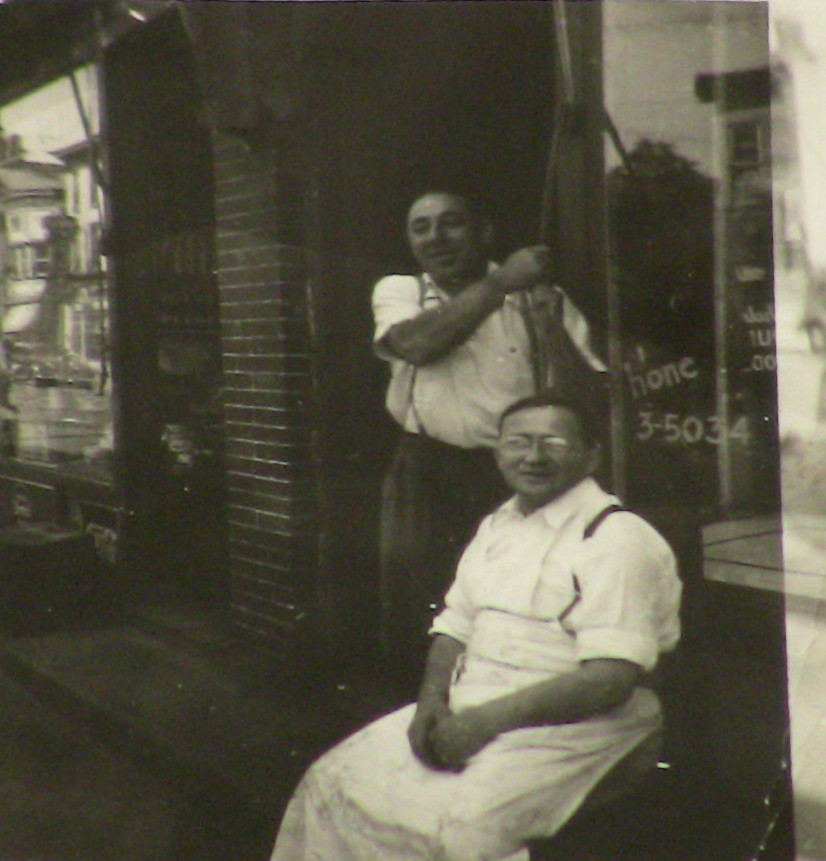 |
| Eremyi Hayfetz in front of Hayfetz Meat Market from Edith Hayfetz Gordon |
And then, a couple of weeks ago, I got an e-mail from Myron Hafetz, whose grandfather, “David Hafetz passed on his store to his son(s) Joseph and Frank Hafetz who were my father and uncle. Joe left the business in the 1940's to go into the scrap metal business. Frank continued and as any of their many customers will tell you, Frank was really an artisan. His wife Nettie continued with the store when Frank died prematurely in 1956 or 57. Their stores were in the Market and Union Street areas.”
He went on to say that “Julius and George Hafitz (sic) (and Edie) are the nephews (and niece) of David and their father opened a competing store in the 30's and you can guess how that went down. In fact, when I interviewed Edie in April, she told me how it came to be that the Hayfetz’s wound up two doors down from the Hafetz’s.
 |
| Julius J. Hayfetz in front of Hayfetz Meat Market from Edith Hayfetz Gordon |
Eremyi Hayfetz came to the United States from Russia in the 1920’s. He and his wife arrived in Trenton with their young son, Julius. “When my Dad came to this country, he didn’t want to work on the Sabbath and he didn’t know what to do." Edie recounted. “And so he decided to open up the butcher store, and this place was available. Unfortunately it was two door’s away from my Uncle’s butcher store. And they eventually became in competition with one another.”
The days were long for a kosher butcher in Trenton in the 1930’s and 40’s. Edith recalls her father waking up early in the morning. “My dad used to open the store around five or six o'clock and then he would go to Kohn's bakery, after he got the orders made up and ready to be delivered, he would go to Kohn's bakery and buy hot fresh rolls and bring them home and we would them for breakfast.” One of her father’s employees was a black man named Eddie. He worked at Hafitz’s for years and “learned to speak Yiddish, and people would come into the store and he would talk to them in Yiddish as though he were one of us.” In fact, Herm Finkle, who lived in the area remembers, “he spoke better Yiddish than some of us Jews did. I can still see him walking toward the slaughterhouse, chickens in each hand, flapping away, walking down the alley to the slaughterhouse.”
I asked Edie how the City of Trenton and specifically the Broad and Market area could support 7 kosher butcher shops and she said, “while they were all I think Europeans coming to this country and they kept kosher. And most of our customers were in the western section, Bellevue Ave., West State, all these small streets off of West State we had customers, Gen. Greene Avenue, I remember.”
Shopping in those days was much different than it is today. There were no supermarkets and without the benefit of freezers, you’d buy only what you could keep. For those who lived in different sections of the city, a trip to downtown Trenton was a special outing. Shoppers would go from store to store, selecting their deli, fresh produce, eggs, and meat. A shopping trip took a lot longer than it does today and in some ways, that was a good thing. “It wasn't like you went into our store and picked up a steak,” says Edie. “You had to wait until Dad brought the side of beef out and cut the steak and trimmed it, and you waited. It all took time and that's when you began talking to everybody. It was a whole different lifestyle than what we have today, and what an interesting thing, that it all worked.”And sometimes, you had to go to extraordinary measures to keep your purchases fresh.
Edie remembers the time when her boyfriend/soon-to-be-husband, Arnie, came to her house for Rosh Hashanah. He got the surprise of his life when he went upstairs to use the bathroom. “All of a sudden he hears this swish, swish, and he couldn't imagine what this was.” Arnie picks up the story, laughing. “Not in my wildest dreams could I imagine what was happening. After I finished my business I got up, and lo and behold there were two huge fish, swimming in that bathtub. And I never heard of such a thing.” They weren’t pets, they were the next night’s gefilte fish. According to Edie, her Mom “didn't want to buy them at the last minute because the fish that came in first were fresher and better.”
When she was old enough, Edie would make deliveries for her father, but while she could work for him, there was a hard and fast rule. She couldn’t take a job working for anyone else.
“I wanted to work when I was like 15 or 16 years old. I wanted to get a job at Dunham’s for Mother's Day or Father's Day. He wouldn't let me. Why? Because that would show people that it looked like he wasn’t able to support me, that I had gotten the money for myself. So he never allowed me to work,” Edie said. “I could deliver orders, I could do all that kind of stuff, but I wasn't able to go out and get a job until after college when I graduated.”
Education was important to the first-generation merchants who lived and worked in “Jewtown”. Edie Hayfetz went to Temple University. “I would say 98% of the children of the kosher butcher stores became professionals. There were dentists, the Palat's, Dr. Palat was a dentist. I had two brothers George and Julius and they both became physicians, our cousins, the Hafetz’s, at the butcher store a couple doors from ours, Morris was a doctor as well.” Their parents worked hard and it paid off. They also wanted to make sure that their children had more opportunities than they did and saw schooling as their way out of the neighborhood. Their dedication to the education of the next generation may have been the biggest contributing factor to the demise of “Jewtown”.
Trenton Trivia- In his e-mail to me, Myron Hafetz mentions that not only were his father and uncle responsible for their business, but “Frank and Joe are responsible for bringing Irv Weinstein to rent one their properties and Frank moved across the street. Debbie (Hafetz) Babashack can give you more details about the store when her mother ran it.”
If you're out there Debbie, I’m waiting to hear from you.
---
I met with Linda Meisel of Jewish Family and Children’s Service earlier this week to discuss a project commemorating the 75th anniversary of the agency. If you have any memories of how JFCS has touched your family’s life, please e-mail me.
---
This morning (Sunday), there will be a funeral at Orland’s in Ewing for Frank Lubitz, who passed away earlier this week. Frank and his wife Ruth were longtime members of Adath Israel and were planning on moving to Florida at the beginning of September. In November of 2009, I had the pleasure of interviewing both Frank and Ruth. Ruth was saved by the Kinder Transport and wound up in Trenton in the mid-1940’s. Frank’s parents opened a bakery when they came to Trenton in the 1920‘s and eventually Frank and his brother owned a fruit store in the ward.
“The last store I bought it we bought was Nicholson's market, where was that on Prince Street, was the oldest store in the city of Trenton. And who are my customers? Mrs. Roebling, who’s husband had a big factory there, they were also customers of ours.” He used to live on Lamberton Street before moving to Morrisville. When I asked him about the area that some called “Jewtown”, he said, “It was an all Jewish neighborhood. It used to be, on all the holidays, people would walk from one shul to the other shul.”
The shuls are all gone in Trenton, and now, it’s too far to walk from one synagogue to another. And chances are that no one will have any fish swimming around in their bathtubs, awaiting their transformation into Gefilte Fish, but if you have memories of what the High Holidays were like in Old Trenton, take a few minutes and send me an e-mail. I’ll make sure to use them in a future entry. L’Shana Tova.
Ed


